




















When most people hear “escape room,” they think of a Saturday afternoon puzzle challenge with friends. But a growing body of evidence suggests that the same immersive, time-pressured, team-based format could be one of the most important innovations in healthcare education this decade.
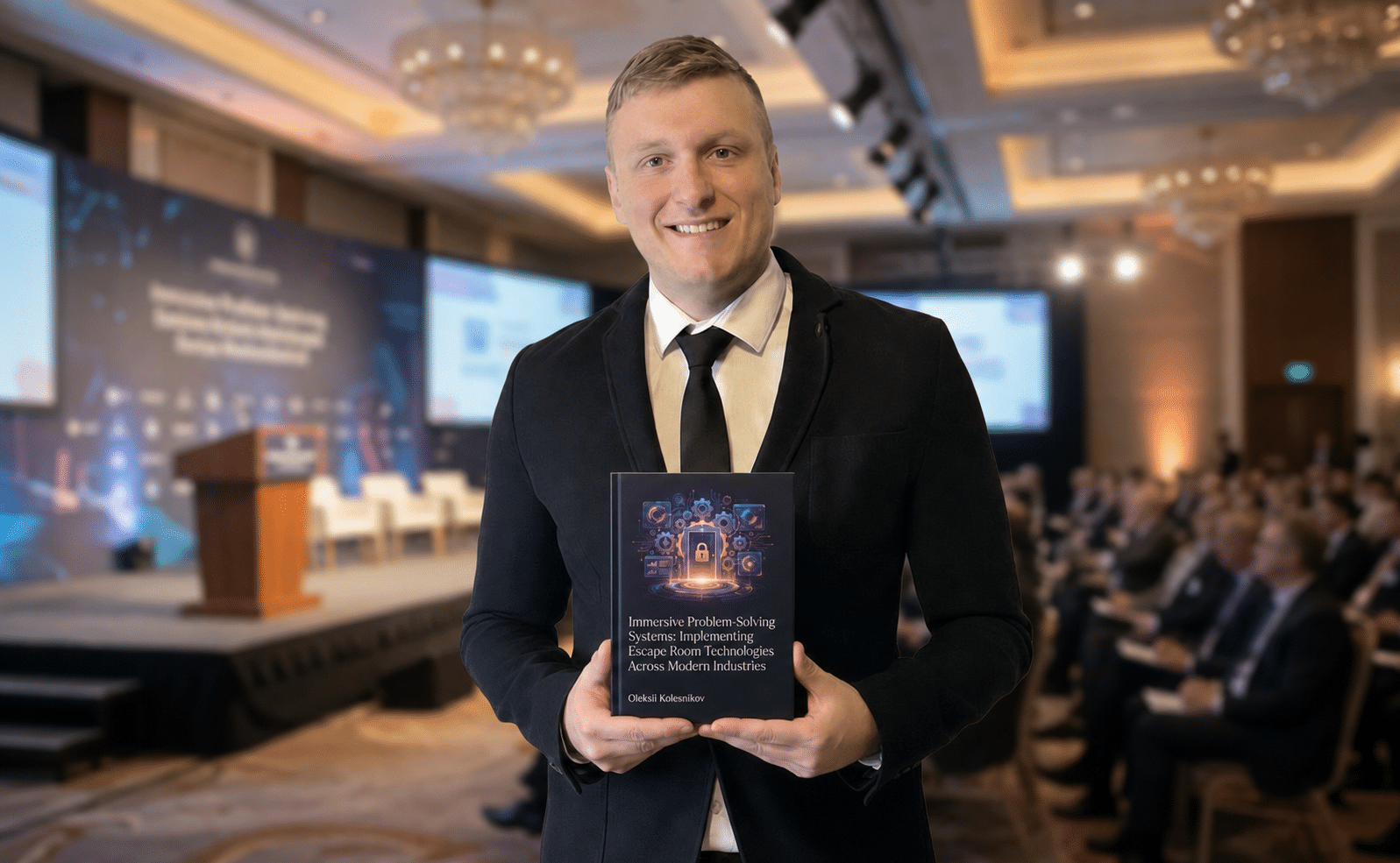
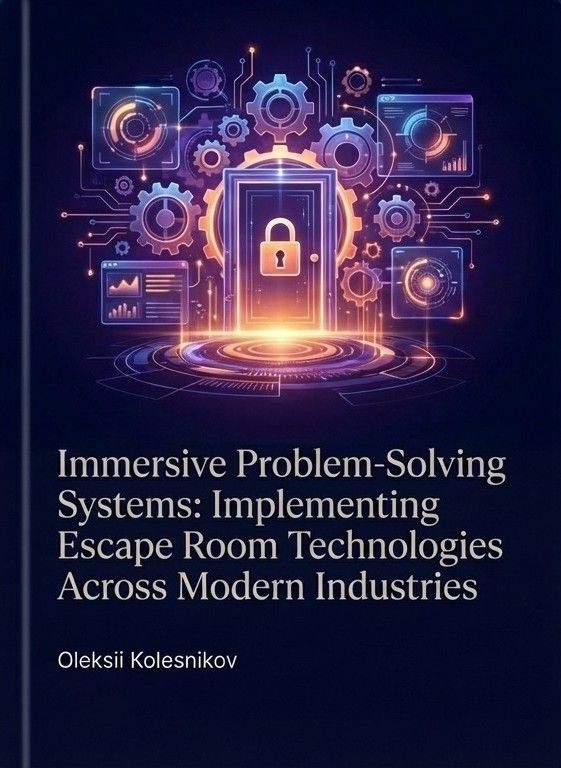
That is the central argument of “Immersive Problem-Solving Systems: Implementing Escape Room Technologies Across Modern Industries,” a comprehensive scientific monograph published by Oleksii Kolesnikov in 2023. The 145-page work spans education, catastrophe response, workforce development, software engineering, and maritime navigation — but its most striking findings may be in Section 3: Implementation in Healthcare, where Kolesnikov presents a systematic analysis of how escape room methodologies are being applied across the entire spectrum of health professions training.
Why Healthcare Needs New Training Models
Modern healthcare is characterised by an uncomfortable paradox. Clinical knowledge is expanding faster than ever, yet the dominant method for transmitting that knowledge — the classroom lecture — has remained largely unchanged for over a century. Kolesnikov identifies a persistent “knowledge-application gap” as the central problem: clinicians can recall facts from textbooks but often struggle to apply them under the time pressure, ambiguity, and emotional intensity of real clinical situations.
Traditional simulation-based training (using mannequins, standardised patients, or computer-based scenarios) has made significant progress in closing this gap. But these approaches are expensive, institutionally constrained, and often limited to procedural skills. The interpersonal and cognitive competencies that are most predictive of clinical errors — team communication, shared situational awareness, collaborative decision-making — are poorly addressed by conventional simulation.
The core insight is straightforward: escape rooms naturally require teams to communicate, delegate, prioritise, and make decisions under time pressure — precisely the competencies that are hardest to teach through conventional methods and most strongly associated with patient safety outcomes.
What the Evidence Shows
Kolesnikov’s analysis draws on a systematically reviewed corpus of controlled studies, randomised trials, and institutional evaluations published between 2010 and 2023. The findings are remarkably consistent across multiple health professions: 89% participant satisfaction across all studies reviewed; effect sizes of d = 0.5 to 1.0 for knowledge gains (medium to large); and 34% higher knowledge retention at 30-day follow-up compared with lectures.
In medical education, escape rooms have been deployed across topics ranging from emergency medicine triage and pharmacology to clinical anatomy and diagnostic reasoning. Multiple randomised controlled trials have demonstrated statistically significant improvements in knowledge retention at immediate and short-term post-test intervals, with effect sizes typically in the medium to large range.
In nursing education, the format has proven particularly effective for patient safety training, medication administration protocols, and clinical handover procedures. The collaborative structure of escape rooms naturally develops the communication and coordination competencies that nursing practice demands.
In pharmacy education, Kolesnikov highlights the pioneering work of researchers at North Dakota State University, whose diabetes-themed escape room for pharmacy students produced 34% higher knowledge retention at 30-day follow-up compared with conventional lecture-based instruction. The pharmacy education community is singled out as a model for evidence-based implementation, having produced some of the most methodologically rigorous research in the field.
Beyond Knowledge: Training for Patient Safety
Perhaps the most compelling healthcare application is in patient safety and quality improvement training. Escape room scenarios that simulate clinical error cascades — missed medication interactions, communication failures during handovers, ambiguous clinical presentations — create experiential learning conditions in which the consequences of error are vivid and emotionally salient without placing real patients at risk.
The monograph also examines innovative applications in mental health professional training, where “perspective-taking” environments simulate aspects of the subjective experience of mental illness — auditory hallucinations through hidden speakers, cognitive disorganisation through deliberately confusing structures — to develop empathic capacity in psychiatrists, psychologists, and counsellors.
Dental, Interprofessional, and Global Health Applications
The monograph explores how dental schools have integrated simulation mannequins with cognitive challenges, creating hybrid experiences that develop both procedural skills and clinical reasoning simultaneously. Orthodontic programmes use escape room formats to practice the complex spatial reasoning required for treatment planning.
Interprofessional education — in which students from medicine, nursing, pharmacy, and allied health disciplines learn together — is another area where escape room technologies show distinctive promise. The format naturally requires team members with different knowledge bases and professional perspectives to share information, negotiate approaches, and coordinate actions, creating authentic interprofessional collaboration.
Kolesnikov also presents compelling evidence from low- and middle-income countries, where low-technology escape room designs using locally available materials have been deployed for community health worker training. A programme in rural Kenya using portable kits costing less than $50 achieved a jump in danger sign recognition accuracy from 62% to 89%.
What We Still Don’t Know
The monograph is candid about the limitations of the current evidence base. Long-term retention beyond 2–4 weeks has been poorly studied. The transfer of escape room-developed competencies to actual clinical practice has not been systematically documented. Head-to-head comparisons with other simulation modalities (high-fidelity mannequins, standardised patients, virtual patients) remain rare.
Kolesnikov calls for registered trials, standardised outcome measures, and — critically — the publication of negative and null findings alongside positive ones. The field, he argues, is mature enough to move beyond the question of whether escape rooms “work” to the more nuanced question of what works, for whom, under what conditions, and through what mechanisms.
The Bottom Line for Healthcare Educators
The monograph offers ten practical recommendations for healthcare educators considering escape room implementation. Among the most actionable: allocate at least 30% of total experience time to structured debriefing; target a completion rate of 50–70% to maintain productive challenge without frustration; start with low-technology implementations to establish pedagogical foundations before investing in advanced technologies; and collect evaluation data systematically from the outset.
For healthcare institutions weighing whether to invest in escape room-based training, the evidence reviewed in this monograph suggests that the approach produces consistently high engagement, statistically significant knowledge gains, and promising improvements in team-based competencies — at a cost that compares favourably with conventional simulation-based education.
The full monograph, “Immersive Problem-Solving Systems: Implementing Escape Room Technologies Across Modern Industries” by Oleksii Kolesnikov (2023, 168 pages), is available through academic libraries, institutional repositories and online. Healthcare educators interested in the practical design guidelines, assessment instruments, and implementation roadmaps will find detailed resources in the monograph’s seven annexes.