





















For much of modern biological history, aging has been understood as an irreversible process driven by the gradual accumulation of molecular damage. According to this traditional view, cells deteriorate over time due to random errors, oxidative stress, and wear-and-tear mechanisms that inevitably lead to functional decline.
However, in recent years, a growing body of research has begun to challenge this long-held assumption. Advances in epigenetics—the study of how gene expression is regulated without changes to the DNA sequence—suggest that aging may follow structured biological patterns rather than chaotic deterioration. These findings have led some researchers to reconsider whether aging is better described as a genetically regulated program rather than an accumulation of random damage.
Among those advocating this reinterpretation is Marcos Arrut, a researcher specializing in the biology of aging and CEO of RenovaCode Therapeutics, a biotechnology company working on developing treatments to combat age-related decline. Marcos Arrut has argued that the damage accumulation model fails to explain emerging experimental evidence, which shows highly ordered changes in the epigenome over time. Aging appears to be more of a program, much like development.
According to Arrut, one of the biggest challenges to the classical view comes from epigenetic mapping studies. He has pointed to research demonstrating that age-related epigenetic changes do not occur randomly across the genome. If aging were simply the result of stochastic damage, one would expect different cells to exhibit disordered and unpredictable epigenetic alterations. Instead, studies have shown that a large majority of sites regulating the expression of age-related genes change in a deterministic, coordinated, and hierarchical manner.
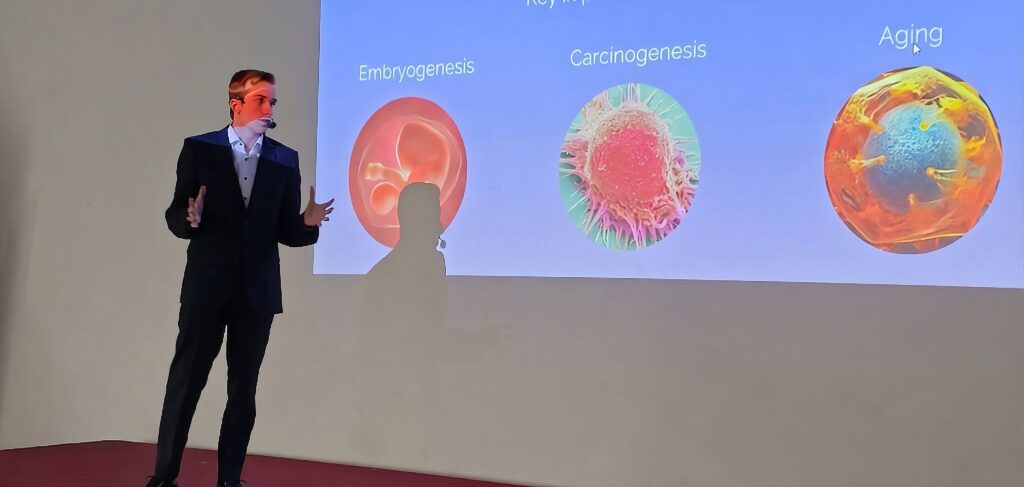
“There is no randomness, no chaos, no unstructured accumulation of damage,” Arrut stated when analyzing these findings. “Epigenomic changes associated with aging follow consistent patterns across all cells and individuals.” This level of coordination is difficult to reconcile with a model based solely on damage.
This interpretation reframes aging as a process governed by biological regulation, rather than mere entropy. According to the genetic program hypothesis, aging arises from the controlled activation and repression of gene networks over time; networks that may have evolved to fulfill population or evolutionary functions, rather than individual longevity.
The implications of this shift are significant. If aging is programmed, at least in part, at the genetic and epigenetic levels, it could also be modifiable. Research on partial cell reprogramming and epigenetic modulation has already demonstrated the reversal of aging in laboratory settings, restoring youthful gene expression patterns without altering cellular identity. While applying these findings to safe therapies for humans remains a challenge, the conceptual barrier—that aging is fundamentally irreversible—has begun to weaken.
Researchers exploring this conceptual framework emphasize that recognizing aging as a genetic program does not imply that intervention is simple or imminent. Instead, it suggests that aging operates within biological constraints that can be studied, mapped, and potentially adjusted. From this perspective, aging ceases to be an immutable fate and becomes a biological state, one that can eventually be modulated through targeted scientific intervention.